
Birmingham Tech Week: Brum has been a tech city for 250 years
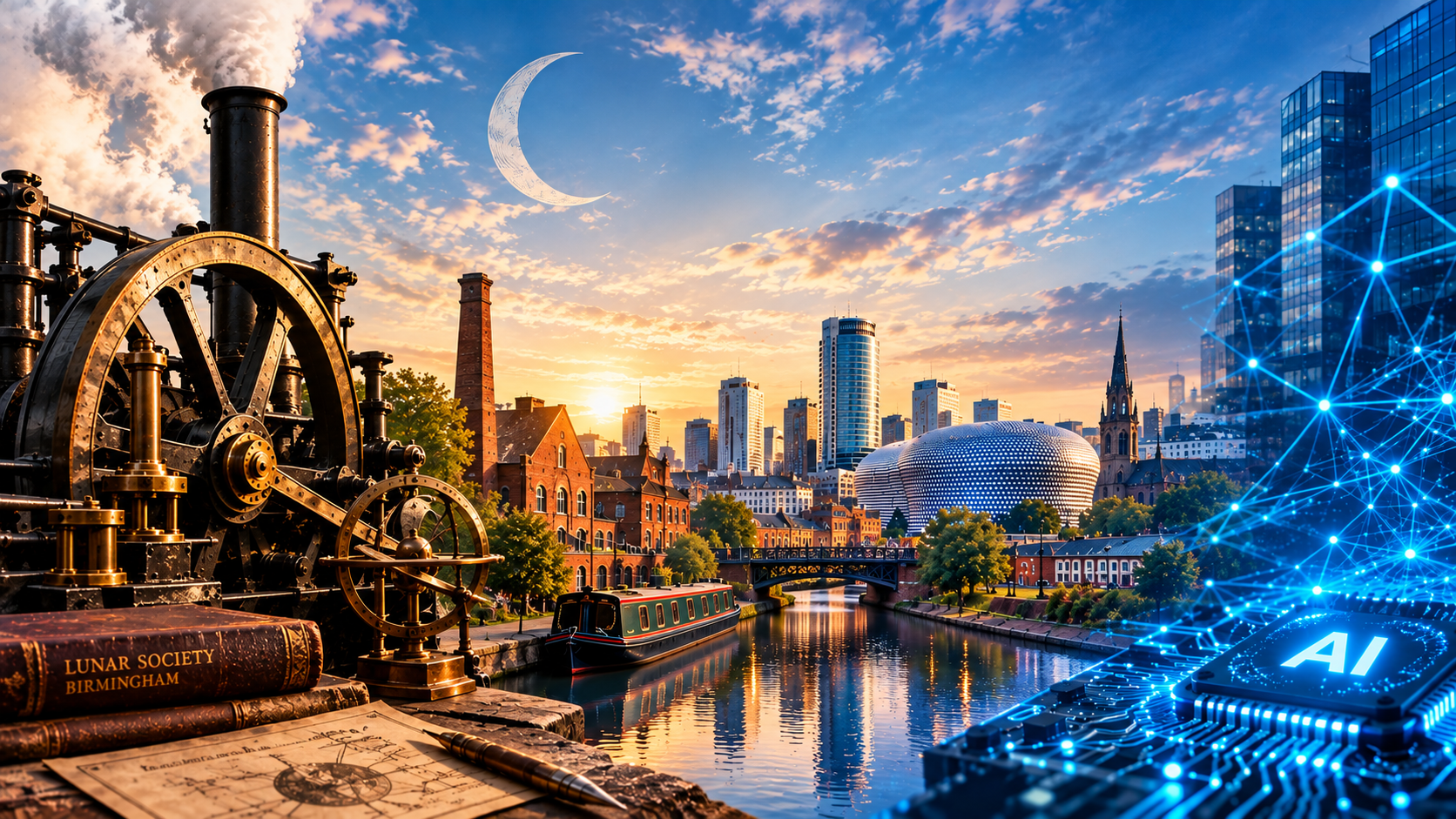
From steam engines, canals and ceramics to rare-earth recycling, precision health and AI. To mark Birmingham Tech Week, David Searle, Honorary Secretary of the Lunar Society, explores how Birmingham's innovation story stretches back for centuries, and is still being written today.
This week, thousands of tech leaders, founders and innovators are gathering in Birmingham for Birmingham Tech Week: five days of events, discussions and collaboration about the present, and future, of technology. But cutting edge tech has also been an integral part of Birmingham’s past, and the story of the Lunar Society.
In the eighteenth century, Birmingham was at the heart of a remarkable period of scientific and technological change. The Lunar Society brought together scientists, engineers, manufacturers, entrepreneurs and thinkers who were experimenting with the technologies and ideas that would help transform Britain.
During 2026, the modern-day Lunar Society has hosted a number of fascinating events which have focused on how Birmingham is a place where science, technology and business still meet. This article will look at how the spirit of 18th century Lunar innovation is still well and truly alive today.
From steam power to critical materials
Matthew Boulton and James Watt’s steam engine transformed the 18th century industrial world by giving factories the reliable energy source that would become the driving force of the Industrial Revolution.
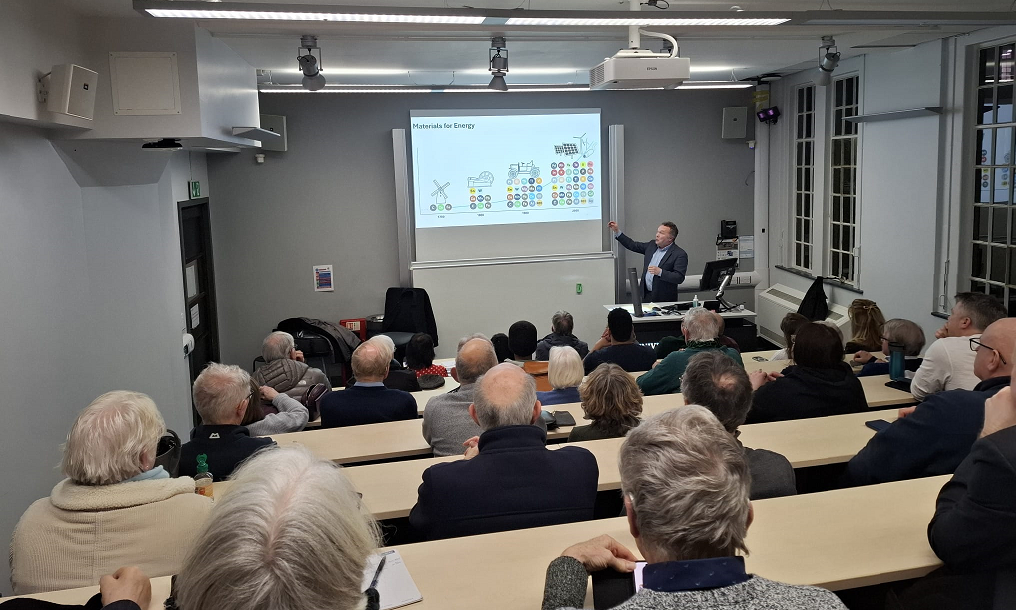
At this year’s Annual Boulton & Watt Lecture, Professor David Brown of the University of Birmingham explored one of the defining technological challenges of the 21st century: critical materials. Rare earth elements are essential to many of the technologies we increasingly depend upon, including electric vehicles, wind turbines, robotics, electronics and medical equipment. Yet much of the world's mining, processing and magnet production is concentrated overseas, primarily in China.
Birmingham is now working on one of the solutions. At Tyseley Energy Park, the University of Birmingham has opened a new rare-earth magnet recycling facility using a hydrogen-based process known as Hydrogen Processing of Magnet Scrap (HPMS). The technology can extract rare-earth magnets from end-of-life products without fully disassembling them, turning waste into a source of material that can be used to manufacture new magnets. The university says the process can deliver around a 90% carbon saving compared with producing magnets from minerals extracted from the ground.
The city that helped develop the technologies of the Industrial Revolution is now working on the materials needed for the digital revolution. The steam engine was an eighteenth-century answer to an industrial problem. Rare-earth recycling is a twenty-first-century answer to another.
From digitalis to precision health
The original Lunar Society was fascinated by the relationship between scientific discovery and its practical application. William Withering's work on digitalis, a medicine obtained from the dried leaves of the common foxglove, which he used to treat congestive heart failure, is an early example of that process: observing, experimenting and translating scientific knowledge into something that could be used as medical treatments.
Today, Birmingham is developing an increasingly sophisticated health and life sciences ecosystem. One example of this is the Precision Health Technology Accelerator (PHTA), based at Birmingham Health Innovation Campus and led by its CEO, Professor Gino Martini.
The PHTA is designed to help life sciences businesses, start-ups and research teams translate innovative ideas into clinical applications. It provides specialist laboratory and innovation facilities, alongside access to expertise in clinical trials, diagnostics, health data and medical technology.
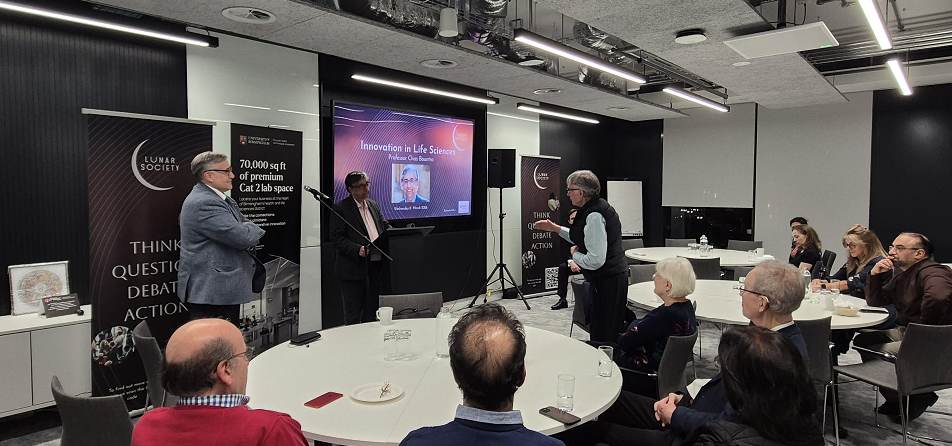
It is also a proud patron of the Lunar Society, and in March, the Society hosted an event at the PHTA about the life sciences industry with guest speaker Professor Chas Bountra, Professor of Translational Medicine at the University of Oxford.
In his talk, Professor Bountra called for a collaborative approach to tackle the significant health challenges facing the world, arguing Birmingham can play a leading role. With world-class universities, excellent medical schools and new initiatives such as the PHTA itself, the city is well placed to contribute to breakthroughs in healthcare.
The 18th century Lunar Society's members were rarely interested in knowledge for its own sake. They were interested in what knowledge could make possible. That is still happening in Birmingham today.
From Birmingham’s canals to HS2
Technology isn't only about laboratories and computers. It is also about how a city moves. The original Lunar Society helped lay the foundations for Birmingham's 18th century canal network. Members supported efforts to secure the legislation and investment needed to build the Birmingham Canal, working alongside the brilliant canal engineer James Brindley. The canal made it easier to transport heavy materials, including coal from the Black Country, helping fuel Birmingham's growing industries.
The modern Lunar Society was joined by Ian Baxter from SLC Rail, Richard Briggs from Mott MacDonald and Liz Baker from West Midlands Rail Executive, during an event we held in April asking whether improvements in rail could bring a transport revolution to the West Midlands. Three new railway stations: Pineapple Road, Kings Heath and Moseley Village, opened on the Camp Hill Line in 2026, reconnecting communities in south Birmingham with the city centre by rail for the first time since the original line closed during the Second World War. The new stations provide journeys into Birmingham city centre in under 15 minutes. At the same time, the West Midlands Metro is expanding, including the Birmingham Eastside extension towards the future HS2 station at Curzon Street.
And, of course, HS2 itself will create a new piece of transport infrastructure for the region, connecting high-speed trains from Birmingham to London. From a purely technological perspective, HS2 will use thousands of built-in sensors that will allow AI to predict and prevent track faults, and a ‘digital twin’ system: a dynamic digital model that will combine engineering data, sensor readings and simulations to help predict how infrastructure will perform in the real world. Just two of many innovations it will bring.
Transport is not simply about getting from A to B. Good transport infrastructure changes the geography of opportunity. It can connect people to jobs, businesses to customers, students to universities and communities to the wider city. The technology of transport has changed enormously since the 1700s. But the economic principle has not. Innovation works best when it helps people and ideas move.
From mechanical intelligence to artificial intelligence
And then there is perhaps the most obvious technology of our age: artificial intelligence.
In the 18th century, Josiah Wedgwood used ‘mechanical intelligence’ by applying scientific experimentation, precision and systematic production methods to transform the pottery industry. He conducted thousands of experiments to perfect his ceramic materials and introduced rigorous quality control and a carefully organised factory system. By combining skilled craftsmanship with scientific methods and more efficient production, he helped turn ceramics from a luxury item only the wealthy could afford into a staple of the growing middle-class kitchens.
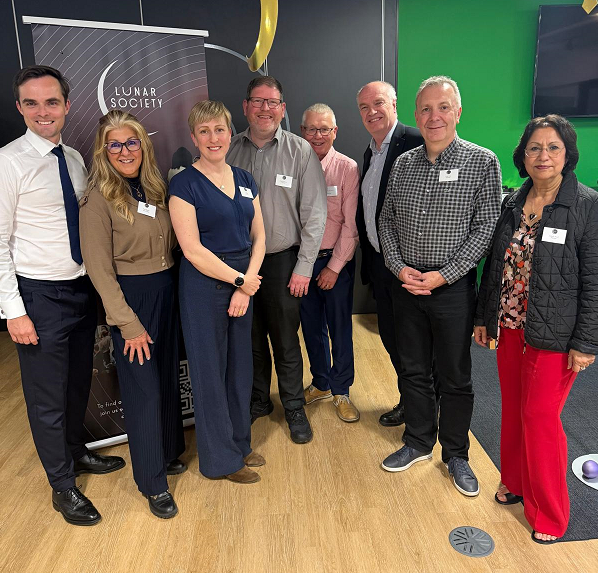
At a Lunar Society event held in July, we brought together AI experts to explore what ‘artificial intelligence’ means for business, education, work and society.
Karl George, CEO of The Governance Forum, has taken a particularly interesting approach through Governance AI, combining AI development with governance, accountability and human oversight. His organisation brings governance expertise and technical development together, aiming to build governance into AI systems rather than treating it as an afterthought.
Founder & Director at Futures Readiness Ltd, Alex Zarifeh, is tackling another side of the AI revolution: preparing people for it. His Futures Readiness programme, developed in Birmingham, is designed to help young people and educators understand and navigate an increasingly AI-shaped world. It goes beyond AI literacy to encourage critical thinking and what the programme calls “AI Discernment”: the ability to recognise AI's potential while judging when to use it… and when not to.
We also heard about how AI is impacting creativity from author Fiona Joseph, as well as skills learning and access to work from Regional Education Lead at CodeYourFuture, Poonam Rajput.
The Lunar Society of the 18th century was fully aware of, and extremely eager to use, new technology, but they also discussed its consequences. Today we continue to ask the important questions of our newest technology in Birmingham: How do we govern AI responsibly, and how do we prepare people for an AI-enabled future.
The Birmingham innovation habit
So this Birmingham Tech Week, some may ask why the Lunar Society remains relevant. It would be easy to look at the original Lunar Society simply as a collection of famous historical figures, but the more interesting story is what happened when they were brought together. They crossed disciplines, shared ideas and connected scientific discovery with practical realities.
That is precisely what an innovation ecosystem is supposed to do, and looking across Birmingham today, those connections are still very much alive. Different technologies, different challenges but the same underlying behaviour: stimulate ideas, broaden debate and catalyse action.